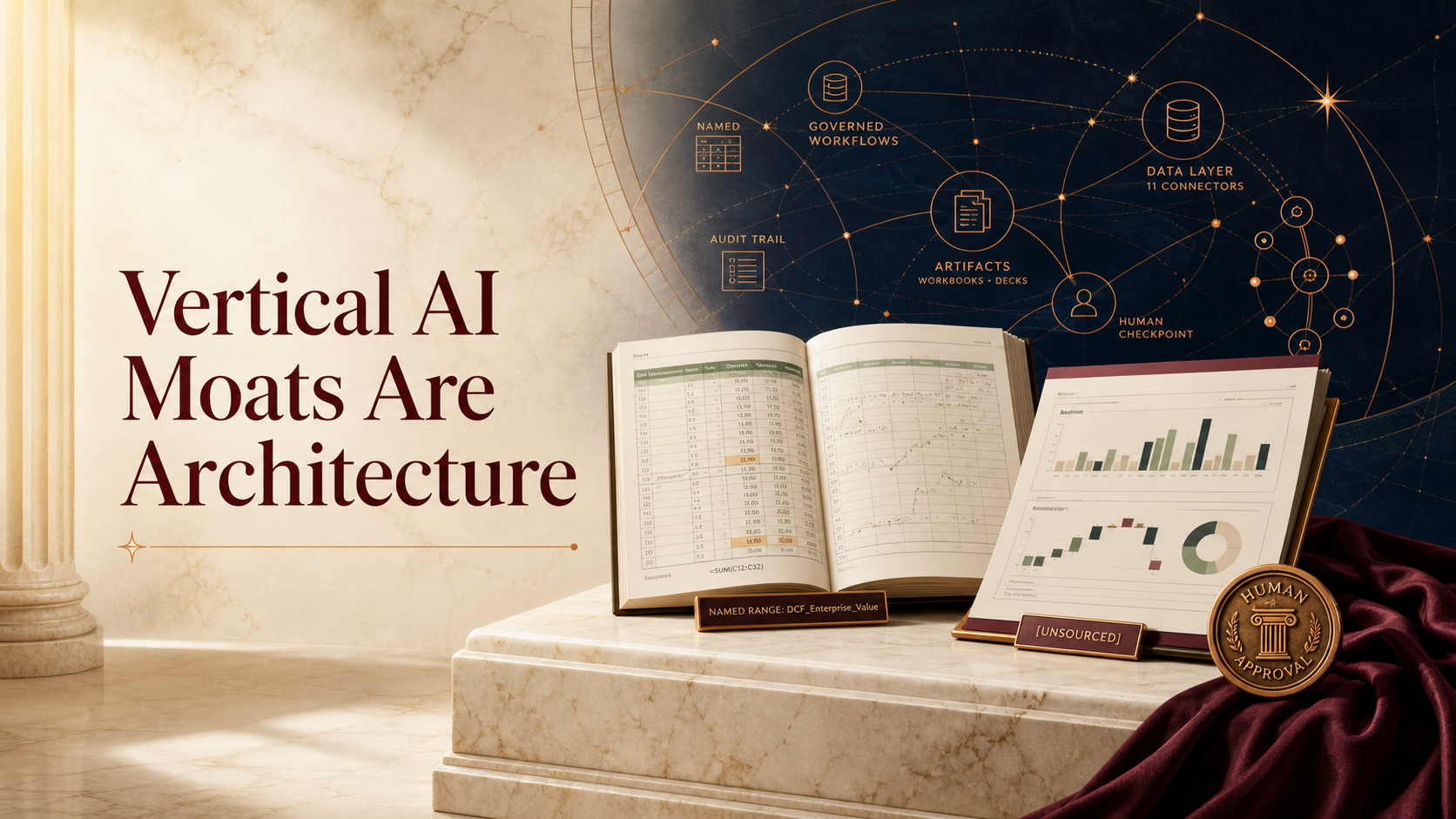
The interesting thing about Anthropic’s Claude for Financial Services repo is not the agents.
It is the architecture.
Anthropic has published a set of named financial-services agents: Pitch Agent, GL Reconciler, Earnings Reviewer, KYC Screener, Model Builder, and others. On the surface, it looks like another “AI for finance” release.
Look closer and three decisions tell you this was written for banks, funds, research desks, and finance operations teams that have to live with the output after the demo ends.
The output is a workbook and a deck
The Pitch Agent does not stop at a chat answer.
It pulls comps, builds a DCF and a football-field analysis, and writes the work into Excel and PowerPoint-shaped artefacts. The workbook matters because formulas remain live. The deck matters because senior people still make decisions from slides, not chat transcripts.
That sounds mundane until you have watched an analyst redo an entire AI-generated answer because the output landed in the wrong format.
In finance, the artefact is part of the control surface. If the number on a slide traces back to a named range, an associate can inspect it, an MD can challenge it, and a compliance team has something to audit.
A chat answer does not give you that.
One source, two deployment paths
The repo also treats deployment as a first-class design choice.
The same system prompt and skills can run as a Claude Cowork plugin, where an analyst opens it inside their working environment, or as a Managed Agents API cookbook, where an operations team runs it headless behind a workflow engine.
That matters because financial institutions rarely have one clean adoption path.
One desk may want a human-facing copilot that helps an analyst move faster. Another team may want a controlled background process that stages a month-end reconciliation pack for review. The workflow is different, but the underlying agent contract should not have to fork.
Most agent frameworks make you pick a lane too early.
This one keeps the source of truth in files, then lets the firm choose where the work runs.
The data layer is real
The giveaway is the data layer.
The financial-analysis plugin includes MCP connectors for Daloopa, Morningstar, S&P Global, FactSet, Moody’s, MT Newswires, Aiera, LSEG, PitchBook, Chronograph, and Egnyte.
That is the part many AI demos quietly postpone.
They show the agent reasoning. They do not show how it gets clean financial data, filings, research, portfolio documents, private-market context, or internal files without someone copying and pasting half the firm’s knowledge into a prompt.
In regulated work, the data layer is not an implementation detail. It is the product boundary.
If the connectors are not in place before you ship, the agent is still a prototype.
The guardrails are the clue
The guardrails are just as revealing as the agents.
No external communication tools. Mandatory human checkpoints after each artefact. Unsourced claims marked instead of smoothed over. Outputs staged for review rather than treated as final.
That is not decorative governance language.
It is the shape of a system built by people who know the answer “the model said so” does not survive contact with a compliance team.
This is the lesson for anyone building vertical AI in regulated work.
The moat is not the model by itself. It is how the agent hands off to a human, where the artefacts land, what can be traced, and which data sources are wired in before the first serious user touches it.
If you are at an investment bank, PE firm, equity research shop, wealth manager, or fund admin, the right question is not “which agent should we copy?”
The right question is what your operating architecture needs to look like:
- which workflows deserve an agent first
- which data sources have to be trusted before anything ships
- which artefacts need to remain editable and auditable
- where human sign-off belongs
- what your compliance team will reject before the pilot even starts
That is the implementation work.
And it is exactly the kind of work we do at Astraeus.
Repo: anthropics/financial-services
Frequently asked questions
What is Anthropic’s Claude for Financial Services repo?
It is a repository in which Anthropic has published a set of named financial-services agents, including Pitch Agent, GL Reconciler, Earnings Reviewer, KYC Screener and Model Builder. The most interesting part is not the agents but the architecture around them: artefacts, deployment paths, data connectors and human checkpoints.
What is the moat in vertical AI?
The moat is the architecture, not the model by itself. It is how the agent hands off to a human, where the artefacts land, what can be traced and which data sources are wired in before the first serious user touches it. That is the lesson for anyone building vertical AI in regulated work.
Why should finance AI agents produce spreadsheets and slides instead of chat answers?
Because in finance the artefact is part of the control surface. A workbook keeps formulas live, and senior people still make decisions from slides. If a number on a slide traces back to a named range, an associate can inspect it, an MD can challenge it and a compliance team has something to audit. A chat answer does not give you that.
What guardrails does Claude for Financial Services use?
The repo uses four guardrails: no external communication tools, mandatory human checkpoints after each artefact, unsourced claims marked instead of smoothed over, and outputs staged for review rather than treated as final. They reflect the fact that the answer ‘the model said so’ does not survive contact with a compliance team.
Which data sources does Claude for Financial Services connect to?
The financial-analysis plugin includes MCP connectors for Daloopa, Morningstar, S&P Global, FactSet, Moody’s, MT Newswires, Aiera, LSEG, PitchBook, Chronograph and Egnyte. In regulated work the data layer is the product boundary. If the connectors are not in place before you ship, the agent is still a prototype.
Where should a bank or fund start with AI agents?
Start with the operating architecture rather than copying an agent. Decide which workflows deserve an agent first, which data sources have to be trusted before anything ships, which artefacts need to remain editable and auditable, where human sign-off belongs and what your compliance team will reject before the pilot even starts.