Explore this guide with AI
Choose your assistant to open a new chat with a prompt about this guide.
Opens the provider's site; sign-in may be needed. For a local preview, or if the AI cannot read the page, copy the full guide below and paste it into the chat.
Copy guide for another AI
Talk it through in your preferred AI chat. Copy the guide and a ready-made prompt, then paste them into a new conversation.
The prompt asks about your business, explains unfamiliar terms and helps you choose a next step. It includes the guide text and source links, so the AI does not need to open this page.
Read or manually copy the briefing
Choosing a provider shares the guide address and explanation prompt with that service. Copying or downloading stays on your device until you paste or upload the briefing. Avoid adding confidential business information, and check the advice against the sources.
Answer engine optimisation (AEO) means making your business easier for AI assistants to find and describe accurately when someone asks for help. An AEO audit checks what those tools can read about you, what they say and what needs attention.
Imagine a café owner asking ChatGPT, “Which accountant in Meath understands hospitality businesses?” They may read a shortlist before visiting any firm’s website. Would your services, location and contact details be clear enough to understand? Would the answer describe the work you actually do?
You do not need to understand the technology to ask those questions. This guide explains why they matter, gives you a quick page check and shows what to expect from a fuller audit.
Last reviewed: 26 October 2026.
- 01 / The question“Who can help me nearby?”
A customer asks for a service, a location and what matters to them.
Accountant for a café in Meath? - 02 / The search or assistantThe tools look for useful information
 Google Search
 ChatGPT
 Claude
Your website, public profiles and other sources can inform what appears. Access and source selection vary.
- 03 / The decisionYour details need to make sense● ● ● yourbusiness.ieWhat you do · Where you work
Who you help · How to enquireThe customer may compare a shortlist before visiting your site or contacting you.
Illustrative journey. Logos identify the products discussed; they do not imply a partnership or that every tool uses the same sources.
Why an Irish business owner should pay attention
Your website is still important. It is also a source that search engines and assistants may use when someone is choosing a supplier. An answer can give a customer the right impression of your business, repeat an old detail or leave you out. You may never see that conversation yourself.
There is evidence that AI use is growing in Ireland and that answers can change how people browse. The figures below measure different things. Neither tells us what percentage of Irish searches has moved from Google to an AI assistant.
Irish use of AI tools is growing
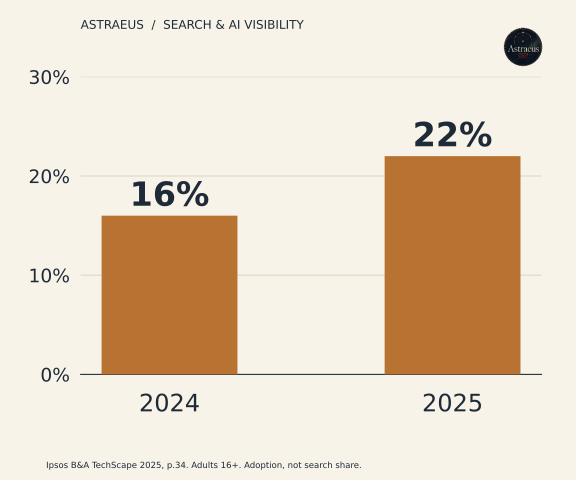
Ipsos B&A reported that 22% of Irish adults used ChatGPT or other generative AI in 2025, compared with 16% in 2024. That is a rise of 6 percentage points.
 Enlarge diagram
Source: Ipsos B&A TechScape 2025, page 34. Adults aged 16+; face-to-face fieldwork in June 2025. The survey question asks about use nowadays, not use for finding businesses.
AI answers can change whether people visit a website
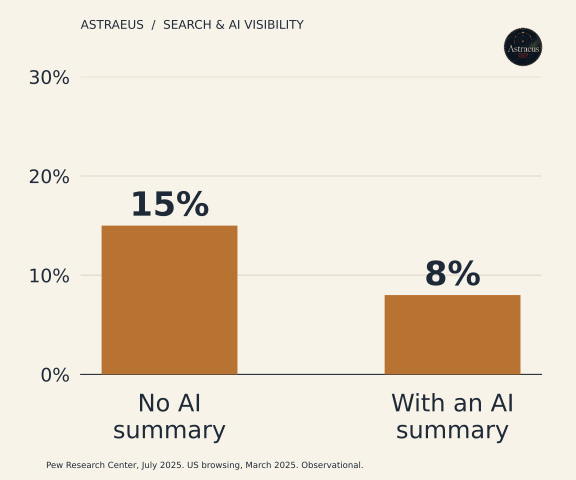
In a US browsing study, a traditional Google result was clicked on 15% of visits without an AI summary, versus 8% with one. The comparison is observational; it does not prove the summary caused the difference.
 Enlarge diagram
Source: Pew Research Center, July 2025. Browsing data from 900 US adults; 68,879 unique Google searches. These figures do not measure movement from Google to another service.
What this means for your business: keep your website useful for visitors, and check whether the answers people read elsewhere describe you correctly. These studies support paying attention. They do not establish how many Irish customer enquiries now come through AI.
The practical response is to stay aware of how people find you. Ask new customers where they heard about the business. Check a few of the questions they ask. Keep your service information and public profiles current. You can do this alongside ordinary search-engine work.
Start with a quick check of your website
Enter a public page below. The result is a rating of basic information in that page, with no email form and no long list of recommendations. It is a starting point, not a completed AEO audit.
Free website check
Check the basics on your website
Enter your homepage or a service page for a quick rating of its basic information. No email needed.
This rates basic website information, not the chance of an AI recommendation. It reads 1 public page and may miss information that loads later. A blocked or unavailable page receives no rating.
What does the rating measure?
Six checks: a title of 10–100 characters (15 points), 1 main heading of at least 5 characters (15), a description of 40–320 characters (10), at least 150 words outside navigation and page furniture (25), an absolute HTTPS canonical address (15), and parseable JSON-LD containing a type or typed graph (20). An explicit noindex or none directive sets the score to 0.
80–100: most website basics detected. 50–79: some website basics detected. Below 50: few website basics detected. These are Astraeus's own rules, not search-engine ranking weights. The check does not validate schema, confirm facts, read robots.txt, check indexing or ask any assistant about your business. It provides a rating rather than a list of fixes.
Your address is sent to Astraeus so the page can be fetched. Query strings and fragments are removed. Submitted URLs and fetched page content are not stored by this checker. Rate-limit counters expire after 1 minute. Use public pages only.
A high score does not mean ChatGPT recommends your business. A low score does not prove customers cannot find you. The tool cannot check your reputation, whether Google has indexed the page, or whether an assistant describes you correctly. Those questions need a wider review.
What an AEO audit checks
A useful audit connects what is on your website with what appears elsewhere. It follows the same stages as our AEO service: record what happens today, clarify the business facts, improve the pages and check again.
What you provide and what the audit should return
Find the pages
You provideService URLs, sitemap and owner reports where available
You receiveA record of pages reached, blocked, indexed or still unknown
Compare business facts
You provideWebsite, business profiles, directories and relevant mentions
You receiveConflicting details, with both source links and an owner to resolve them
Check the answers
You provideService copy, FAQs and the schema behind each page
You receiveSpecific copy, link and markup changes to review
Repeat buyer questions
You provideAgreed questions, Irish location and saved assistant answers
You receiveA dated comparison of mentions, citations and incorrect descriptions
Can the important pages be reached?
Check that your homepage, service and contact pages load, link to each other and appear in your sitemap, the file listing pages for search engines. Check for settings or firewall rules that block automated readers.
A page loading in your browser does not prove that Google has included it in its index. Use the owner’s Search Console or Bing Webmaster reports to check that separately. If access is missing, record it as unknown. Google’s AI search guidance says a page must be indexed and eligible for a search snippet to appear as a supporting link in its AI features. There is no extra technical requirement for those features.
Do the public facts agree?
Compare your website with your Google Business Profile, relevant Irish directories and professional profiles. Look at your name, contact details, opening hours, genuine service areas and the services you currently provide.
Keep both source links when facts disagree. The business owner confirms what is correct. Google’s local guidance stresses complete and accurate business information. Reviews and third-party mentions should be genuine; they are different evidence from claims on your own site.
Can a customer understand what you offer?
Your main service page should answer: what do you do, who is it for, where do you work and how can someone enquire? Put that information in readable text rather than leaving it only in an image.
Check FAQs, links and structured data. Structured data, often called schema, is information in the page’s code that labels things such as the business name or service. It should match the visible page. Google’s guidelines require that correspondence. Adding it is not a shortcut to being recommended.
What do assistants actually say?
Agree a few real customer questions, including questions that do not mention your name. Sample ChatGPT, Copilot, Perplexity and Google AI experiences where available. Save the exact question, date, Irish location or visible location settings, answer and any linked sources.
Record a mention, a link and an incorrect description separately. An assistant can mention you without linking to your site. Its answer may also change between sessions. Save the original result so the next check has something to compare with.
Search access and model training are separate matters. OpenAI documents separate search and training crawlers, and Perplexity publishes its crawler guidance. An audit checks the relevant policy; changing it needs the owner’s agreement.
What useful findings look like
These are illustrative examples, not live assistant tests or client results:
- Needs fixing: an old directory lists the wrong phone number. Keep the directory entry, the website page and the number confirmed by the owner. Correct the listing with approval and check it again.
- Unknown: whether a service page is indexed. The page loads, but the owner report is missing. Request that report before calling it an indexing problem.
- Needs checking: an assistant describes a service you stopped offering. Save its answer and cited source. Find where the old description comes from before proposing a correction.
A report should leave you with a dated question set, source links, a list of findings and an order for dealing with them. Each action needs a person responsible and a clear way to check it afterwards.
Download the audit record and 12-point checklist to keep the evidence together. It includes status labels, action records and the examples above. The DIY visibility guide gives you another way to investigate common problems yourself.
Which fixes should come first?
Start with confirmed problems that stop an important page being reached or could lose an enquiry, such as a wrong phone number. Then deal with missing answers, confusing descriptions and broken links. Agree the order with the business owner.
Use checked for a specific check that passes, needs fixing for a confirmed problem, unknown for missing evidence and needs checking for a possible problem. Keep the date and source beside the status. A corrected directory entry and a changed assistant answer are separate results.
Agree what the audit fee includes before work starts. Straightforward fixes may be included in an agreed scope; larger website work, new pages and ongoing monitoring should be priced clearly. No provider can promise a recommendation, a fixed ranking or an instant change.
What happens as assistants start doing more for customers?
An AI agent can search and take steps on someone’s behalf, rather than only answer a question. For example, Google announced an AI Mode restaurant-reservation experiment in August 2025. It searched multiple sites for suitable availability and linked people to a booking page. The announcement concerned a US rollout, not general availability in Ireland.
Our view: more of the comparison and selection process could happen before someone reaches your website. That makes accurate services, location, opening hours and a clear enquiry or booking route worth maintaining. It does not mean every Irish customer will use an agent, or that Google will stop mattering.
Awareness is the useful first step. Know what these tools say about your business, keep a record and look for changes in real enquiries. You can prepare for new ways of being found without buying into promises of guaranteed AI visibility.
Questions about AEO audits
How do SEO, AEO and GEO fit together?
SEO helps search engines find and rank pages. AEO, answer engine optimisation, helps answer systems find clear answers and their sources. GEO, generative engine optimisation, looks at how assistants describe and cite a business in generated answers. The work overlaps: accessible pages, accurate facts and useful answers support all 3.
Can an AEO audit guarantee a citation or recommendation?
No. An audit records what happened for an agreed set of questions on a particular date. Search engines and assistants choose their own sources, and their answers can change. A baseline helps you check accuracy and track changes; it cannot promise selection.
How long do changes take to appear?
There is no fixed timetable. A corrected page can be checked straight away, but search engines and assistants refresh their information separately. Agree a re-check date and repeat the same questions. Record what changed and what is still missing.
How do I ask about an AEO audit?
Send Astraeus your website, the services you want to be found for and the areas you serve. We can agree the pages, questions and deliverables to include, then confirm the scope and price before work begins.