Entity clarity
One consistent explanation of who Astraeus is, where it works and what it provides.
Search and AI visibility · AEO, GEO and SEO in Ireland
AEO means answer engine optimisation: helping tools such as ChatGPT and Google answer questions about your business accurately. We check what they can find, what they say and which website or business details need attention.
Ask about an AEO audit
A customer might ask for an accountant near Duleek, a clinic in Dublin or a supplier who understands their business. They may read an AI answer before visiting any website. Your services, location and contact details need to be clear wherever that answer draws its information from.
AEO sits alongside ordinary SEO, the work that helps pages appear in search results. It also overlaps with GEO, which looks at how generative AI describes a business. You do not need separate jargon-heavy projects: start with accurate business facts, useful pages and a record of what customers actually see.
Astraeus is based in Meath and Dublin and does this work for owner-run businesses across Ireland, with some clients in the UK. For an Irish business, that means checking how assistants answer questions asked from Ireland, which Irish directories and profiles they draw on, and whether the business facts match across Google Business Profile, Irish listings and the website.
A customer asks for a service, a location and what matters to them.
Accountant for a café in Meath? Google Search
 ChatGPT
 Claude
Your website, public profiles and other sources can inform what appears. Access and source selection vary.
The customer may compare a shortlist before visiting your site or contacting you.
Illustrative journey. Logos identify the products discussed; they do not imply a partnership or that every tool uses the same sources.
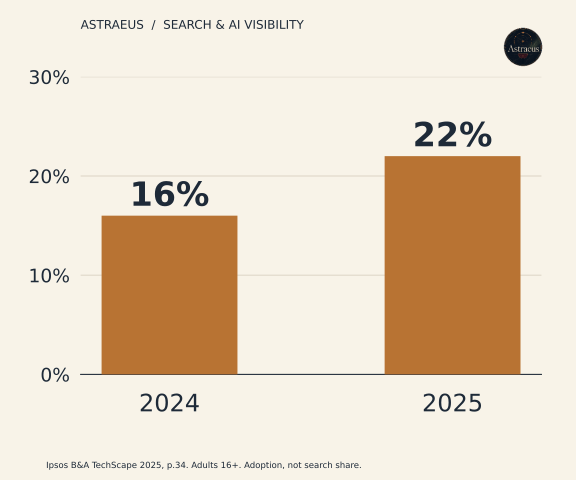
Ipsos B&A reported that 22% of Irish adults used ChatGPT or other generative AI in 2025, compared with 16% in 2024. That is a rise of 6 percentage points.
 Enlarge diagram
 Source: Ipsos B&A TechScape 2025, page 34. Adults aged 16+; face-to-face fieldwork in June 2025. The survey question asks about use nowadays, not use for finding businesses.
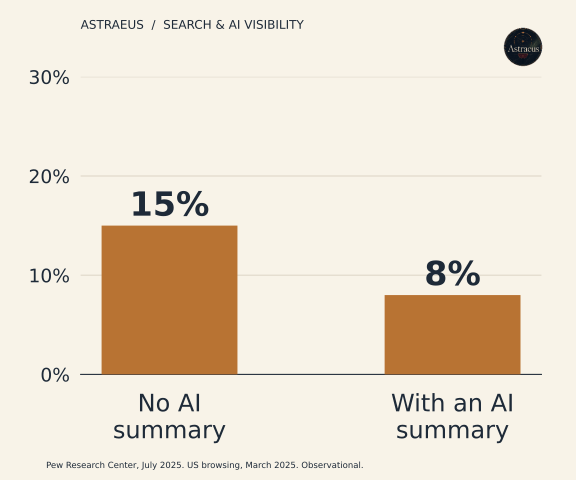
In a US browsing study, a traditional Google result was clicked on 15% of visits without an AI summary, versus 8% with one. The comparison is observational; it does not prove the summary caused the difference.
 Enlarge diagram
 Source: Pew Research Center, July 2025. Browsing data from 900 US adults; 68,879 unique Google searches. These figures do not measure movement from Google to another service.
What this means for your business: keep your website useful for visitors, and check whether the answers people read elsewhere describe you correctly. These studies support paying attention. They do not establish how many Irish customer enquiries now come through AI.
Free website check
Enter your homepage or a service page for a quick rating of its basic information. No email needed.
This rates basic website information, not the chance of an AI recommendation. It reads 1 public page and may miss information that loads later. A blocked or unavailable page receives no rating.
Six checks: a title of 10–100 characters (15 points), 1 main heading of at least 5 characters (15), a description of 40–320 characters (10), at least 150 words outside navigation and page furniture (25), an absolute HTTPS canonical address (15), and parseable JSON-LD containing a type or typed graph (20). An explicit noindex or none directive sets the score to 0.
80–100: most website basics detected. 50–79: some website basics detected. Below 50: few website basics detected. These are Astraeus's own rules, not search-engine ranking weights. The check does not validate schema, confirm facts, read robots.txt, check indexing or ask any assistant about your business. It provides a rating rather than a list of fixes.
Your address is sent to Astraeus so the page can be fetched. Query strings and fragments are removed. Submitted URLs and fetched page content are not stored by this checker. Rate-limit counters expire after 1 minute. Use public pages only.
The quick check rates a few signals on 1 page. A fuller AEO audit compares public facts and actual assistant answers, then agrees what to improve. Read what an AEO audit checks.
The sequence
Agree real customer questions and record the answers, business mentions and linked sources.
Compare your services, location and contact details across the website and public profiles.
Prioritise clearer service answers, useful links and accurate information. Confirm the scope and approvals before changes begin.
Keep before-and-after evidence and record what improved, what stayed the same and what remains uncertain.
Three overlapping disciplines, one shared foundation. Most SMEs need a sensible blend rather than a separate project for each.
| SEO | AEO | GEO | |
|---|---|---|---|
| Stands for | Search Engine Optimisation | Answer Engine Optimisation | Generative Engine Optimisation |
| Optimises for | Ranking pages in search results on Google and Bing | Being the extracted direct answer: featured snippets, voice answers and AI answer boxes | Being accurately described and cited when an AI assistant chooses to use the business as a source |
| The buyer is doing | Scanning a results page and choosing a link | Asking a specific question and reading one answer | Asking an assistant for a recommendation or comparison |
| Core work | Technical health, keywords, content quality, links and local signals | Question-shaped content, direct answer passages and carefully matched structured data | Entity clarity, consistent descriptions across sources, evidence assistants can cite |
| Measured by | Rankings, impressions, clicks and organic conversions | Answer inclusion and accuracy for a tracked question set | How assistants describe and recommend the business across repeated baseline checks |
One consistent explanation of who Astraeus is, where it works and what it provides.
Self-contained paragraphs that answer specific buyer questions without relying on surrounding marketing copy.
Organisation, service, breadcrumb and FAQ schema that matches the visible page.
Links connecting service claims to detailed pages, FAQs, Insights and controlled proof.
Alignment across the website and controlled business profiles, with conflicts recorded for correction.
Sitemaps, canonicals, robots directives and content surfaces checked for accidental blockers.
No provider controls which source an assistant chooses for a particular answer.
Answer systems do not expose one stable list equivalent to a traditional results page.
Machine-readable data helps interpretation but cannot compensate for weak or unsupported content.
Assistants refresh sources on different schedules and may take time to reflect an update.
The honest boundary
AEO and GEO are young disciplines. We can improve clarity, consistency, crawlability and the evidence available to search engines and answer systems. We cannot guarantee a ranking, and we cannot guarantee that a named assistant will cite or recommend a business for a specific prompt.
Direct answers
Yes. Astraeus is based in Meath and Dublin and works with small and medium businesses across Ireland, remotely or on site. The baseline check is run from an Irish locale, so the results reflect what customers in Ireland actually see.
It records how search engines and AI assistants describe the business today, fixes the facts and pages they rely on, adds direct answers to the questions customers ask, and re-checks the same questions over time. The deliverable is a dated before-and-after record, not a promised ranking.
SEO helps pages qualify and rank for searches. AEO also focuses on whether an answer system can identify the business, extract a direct answer and trace the claim to a clear source.
GEO (Generative Engine Optimisation) is about how generative assistants such as ChatGPT, Claude, Gemini and Perplexity describe and recommend a business inside a generated response. AEO focuses on extractable direct answers; GEO focuses on being an accurate, citable source when the assistant composes its own answer. In practice the two share most of their groundwork.
The assessment can sample ChatGPT, Claude, Gemini, Copilot, Perplexity and Google AI experiences. Availability and output vary by account, location and date.
No. It can help machines interpret a question and answer, but it does not cause an answer to be selected. The visible content still needs to be accurate, useful and supported.
Not as an SEO shortcut. Google says it does not use llms.txt for Search ranking or AI features. It can be a small optional index for assistants that choose to read it, but good pages, crawl access and consistent business information matter more.
No. Any provider making that promise is claiming control over systems they do not operate.
No. Crawlability, good pages, local signals, relevant links and technical health remain part of the foundation.
A baseline set of representative questions is recorded, then re-run after changes. The report tracks accuracy, inclusion, cited sources and unresolved inconsistencies.
Send your website, the services you want to be found for and the areas you serve. We can agree an AEO audit scope and price before work starts.
Ask about an AEO audit